Looking at the COVID-19 fallout from an IT perspective, the crisis poses a new set of challenges to major internet communications players such as Telco Operators, ISPs, IaaS providers and OTTs. These challenges are represented by more and more people relying on their home internet connection for work and leisure as a consequence of governments, in most countries, ordering social distancing and forcing private companies and public organizations to make their employees to work from home.
What are the challenges for private companies and public organizations?
Private companies and public organizations, in these weeks, have been forced to prevent their employees from accessing their offices and to encourage smart working. This approach, although not new to knowledge workers, pushed a multitude of new professions to adopt smart working as the sole mean to stay productive. Employees, however, need to rely on stable connections assuring undisrupted data flows in order to use those internet based digital tools for productivity and collaboration, which, for many of them, represents a first.
What are the challenges for the major internet communications players?
Not just smart working, but also home learning and mere social distancing have suddenly put a toll on the existing demand of home internet connections. People, for work, for education or just for leisure, collectively, started using their own domestic connections in a size they had not done before. This new scenario, for the first time, has put in doubt the reliance and strength of not just the internet domestic services provided by Telcos and ISPs, for private purposes but also of an array of other services, provided by IaaS providers and OTTs, used for professional needs that are usually consumed from the office.
Are internet communications companies going to cope?
Yes, they are!
Many major internet communications players (Teclos, ISPs, OTTs and IaaS providers), were quick to explain that there is no risk, despite the surge in demand, there are few moments when a user may be having to fight against a huge number of contemporary requests. However, internet communications professionals say they’re familiar with handling web traffic peaks saving the internet from exploding in rush hours.
How do the major internet communications players face the challenge?
The response of the major internet communications players has been different depending on the type of internet service provided and on the geography. In the UK, for instance, there are a few Telcos and ISPs operators who have said they will be raising data caps so that users can enjoy more bandwidth for the same subscription fee.
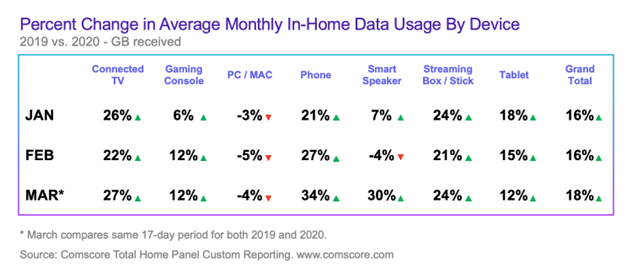
As you can see in the graph below, according to Comscore, there is an increase in average monthly In-home data usage.
According to Comcast, an American telecommunications conglomerate, peak traffic is up 32% overall and 60% in some areas. The company assures: ‘We engineer the network to handle spikes and shifts in usage, and what we have seen so far with COVID-19 is within our capacity’.
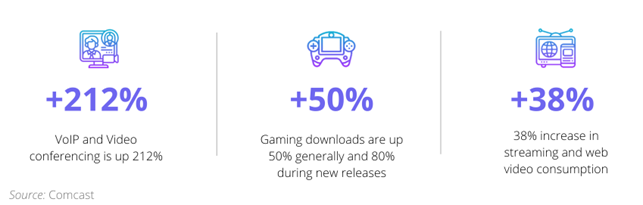
Comcast emphasises an substantial increase of 212% in VoIP and Video Conferencing. Streaming and web video consumption has reportedly grown by 38%, while there is a 50% rise in gaming downloads.
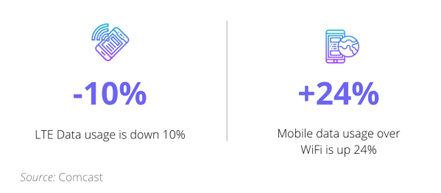
Comcast states that they see a 10% drop in LTE data usage and a 24% raise in mobile data usage over WiFi.
Although Comcast is seeing an extensive shift in network usage, the ISP is confident ‘it’s within the capability of their network.
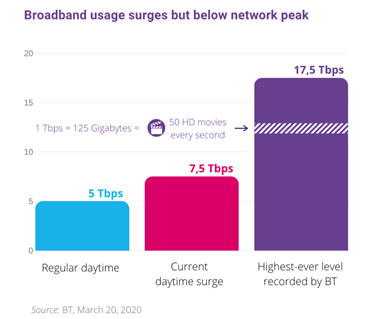
BT, UK’s major Telco operator, claims its broadband infrastructure is well prepared to cope with increased demand as more people stay home due to coronavirus. Yet, BT says that data usage on its network has risen between 35-60%.
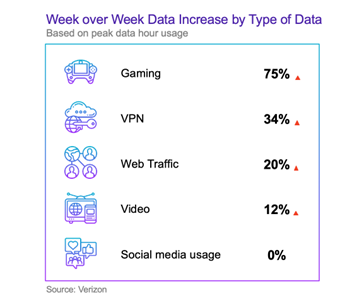
Verizon, an American telecommunications company, also reported an increase in web traffic by less than 20%. As more business employees working from home, Verizon’s network experienced a 34% increase in virtual private networking usage. Nonetheless, while social media usage has unexpectedly remained flat, according to Verizon.
The following chart shows how traffic rose for different types of data.
OTTs gave another huge help to improve connections. YouTube started by inhibiting the playback of high definition (HD) content in favor of a standard definition (SD) playback. Netflix and Amazon Prime Video said they will do the same for the EU. Virgin Media, Sky and finally Disney+, the youngest of the streaming platforms listed so far, are also on the lists of those who will bring video quality to the SD. Comscore stated that streaming hours via CTVs have risen 24% compared to a year ago, and streaming box or stick streamed hours are up 16%.
From March 1 through March 16, Comscore reported notable rise in streaming usage. As shown in the chart below.
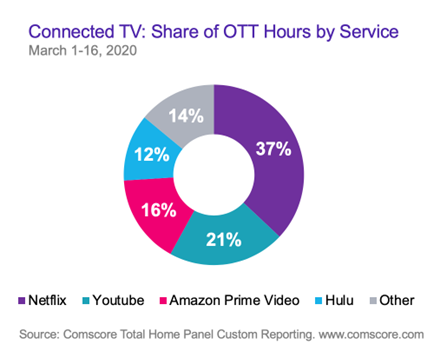
According to Comscore: during the first half of March, Netflix drew a 37% share of OTT hours, followed by YouTube with 21% share; Amazon Prime Video, 16%; Hulu, 12%; and others for 14%.
What about IaaS?
Fortunately, Infrastructure as a Service providers (IaaS) have always had a scalable structure. Consequently, AWS, Google Cloud, Azure, and other IaaS providers won't have to worry about weak connections as much as aforementioned organisations will have to do. So, if you're a cloud user, you can relax.
Behind the scenes of collaboration, video streaming and gaming solutions, which are nowadays at the forefront of public consciousness, IaaS platforms are essential in enabling remote work and entertainment technologies.
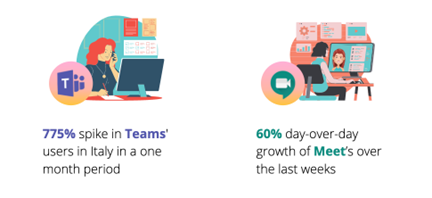
Teams, Microsoft’s collaboration platform based on the company's cloud service Azure, reportedly serves more than 44 million daily users. In Italy, it has seen a 775 percent increase in Team’s calling and meets monthly users in a one month period. Despite the increase in data traffic, Azure’s performance remained good.
As the COVID-19 pandemic keeps a large share of global population at home, Google Cloud also has seen an increase in use of its video conferencing platform Google Meet. According to the cloud giant’s CEO Thomas Kurian, Meet’s day-over-day growth surpassed 60% over the last weeks, skyrocketing its daily usage to more than 25 times what it was in January.
Amazon Web Services (AWS), despite supporting a vast number of widely used web-scale companies, including the shopping platform Amazon, Slack and Netflix maintain smooth operation ensuring the digital world continuity in crisis. AWS didn’t provide numbers on the increased cloud-computing usage during the emergency but stated that the company has ‘taken measures to prepare, and we are confident we will be able to meet customer demands for capacity in response to COVID-19’.
CONCLUSIONS
Poor or slow connection, for now, is an issue of perception. Not only there are data to support this. To the contrary, despite the huge spikes in demand, the internet communications have remained stable. So don’t worry about it. There are much more important things to focus on right now. In the meantime, 5G projects have not stopped- They are continuing towards the creation of a brand-new network connectivity, so, the future remains bright.
You can focus on reducing the contagion without affecting your life on the internet!