BACKGROUND
A government entity in the Middle East responsible for tourism launched a comprehensive business intelligence and data strategy to streamline decision-making and drive digital transformation across its projects and processes. Specifically, facing rapid growth in the tourism industry, the customer sought to elevate visitor experiences while upholding over 160 Quality of Service (QoS) standards for accommodations. As part of this initiative, the customer established an Analytics Lab to design and productionalize AI/ML projects organization-wide, aiming to generate actionable insights from tourism data.
OBJECTIVES
The customer outlined several critical requirements to support their data-driven transformation:
- Developing an integrated Data Analytics Platform with a robust technical foundation to facilitate analytical services, leverage modern technologies, and prepare data for analytical use cases relevant to stakeholders and target sectors.
- Review the business requirements and the outcome of the current use cases, define the gaps (business, data, or modelling), set a correction plan, and deliver the selected use case.
- Data Science Enablement: an extensive plan to enable the customer’ team to become the organization's future data scientist. The enablement program to deliver various Data sciences Training, Development Methodology and Product training.
- Platform Operation: provide required resources to operate the platform and develop future cases.
These challenges underscored the need for an innovative, scalable solution to streamline auditing processes and uphold quality standards, ensuring the tourism sector's continued growth and competitiveness.
THE SOLUTION
KDM Force conducted a comprehensive engagement with partners and the customer to implement a Data Analytics Platform designed to drive digital transformation and enhance operational efficiency. The project progressed through multiple stages, starting with in-depth analysis and tailored system design, culminating in the deployment of a platform capable of collecting, processing, and analyzing data to meet the customer's specific needs.
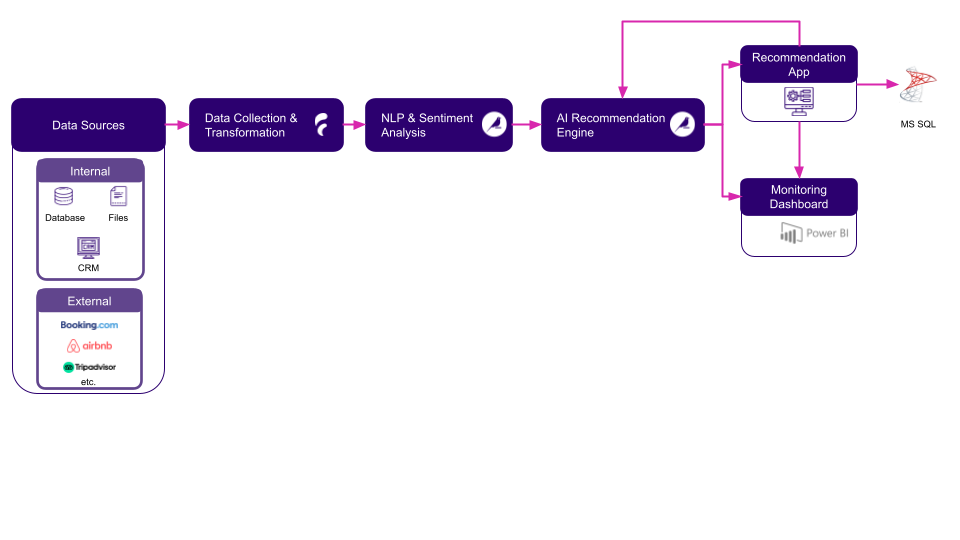
A key highlight of the project was the development of a sophisticated machine learning-based recommendation engine to optimize inspection planning. This engine collected and analyzed data from major social and tourism-specific websites such as Booking.com, Airbnb, TripAdvisor, etc. By leveraging this data, the engine provided actionable insights into accommodation trends, customer reviews, and quality benchmarks, enabling the customer to prioritize inspections efficiently and uphold high standards of service.
To achieve this, we implemented a suite of advanced tools. Fyrefuse played a central role as the Data Engineering tool, populating both Dataiku, where the data was utilized to deploy machine learning use cases, Power BI, which was used for generating detailed reports and dashboards for stakeholders, and last but not least the Recommendation App, where the recommendations to perform the inspections were pushed. This seamless integration ensured the platform could handle both predictive analytics and real-time data visualization, delivering a complete and actionable view of operations.
In addition to the technical implementation, KDM Force provided extensive training to the customer’s team, covering data science techniques, development methodologies, and platform usage. This empowered the customer to independently operate the platform, adapt to changing needs, and develop future use cases.
By employing agile methodology, the project was delivered iteratively, allowing for adaptability and the continuous incorporation of customer feedback. Once implemented, the platform was handed over with all the necessary resources to enable the customer to sustain and scale its use.
KDM Force delivered not just a solution but a transformative system that empowered the customer to make data-driven decisions, laying a robust foundation for long-term growth and innovation in the tourism sector.
USE CASES
For this customer, we developed three key use cases that demonstrated the flexibility and power of the Data Analytics Platform:
- Online Accommodation Platforms Data Acquisition
- Natural Language Processing
- Inspection AI
Use Case 1&2: Online Accommodation Platforms Data Acquisition and Natural Language Processing (NLP)
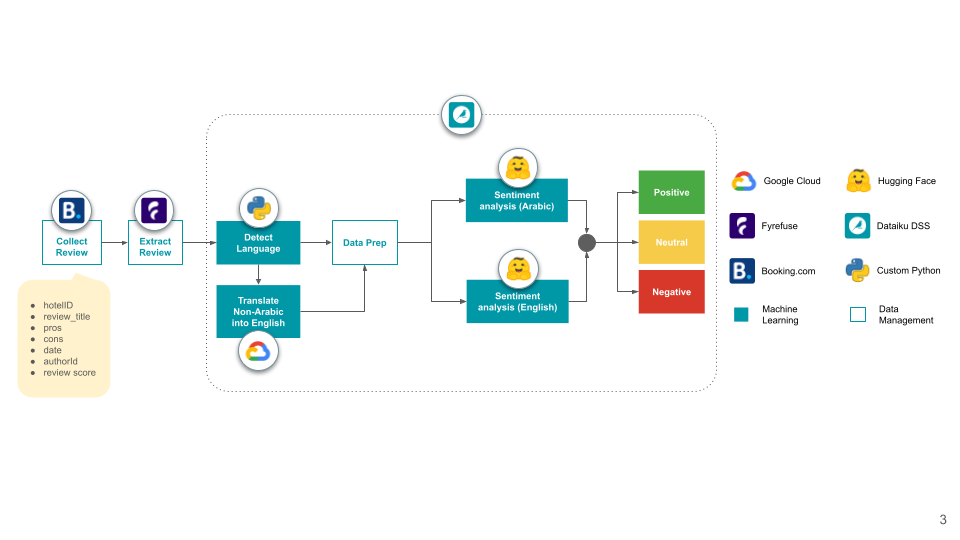
Scope: The goal was to collect and process data on accommodation facilities, including location details, accommodation names, coordinates, cities, grades, reviews, author IDs, dates, facility ratings, and review-specific ratings.
Process: We built 28 data pipelines in Fyrefuse to efficiently collect and process this data. Reviews written in non-English languages were translated into English using the Google Translate API, while Arabic reviews were retained in their original language. This multilingual capability ensured comprehensive data analysis.
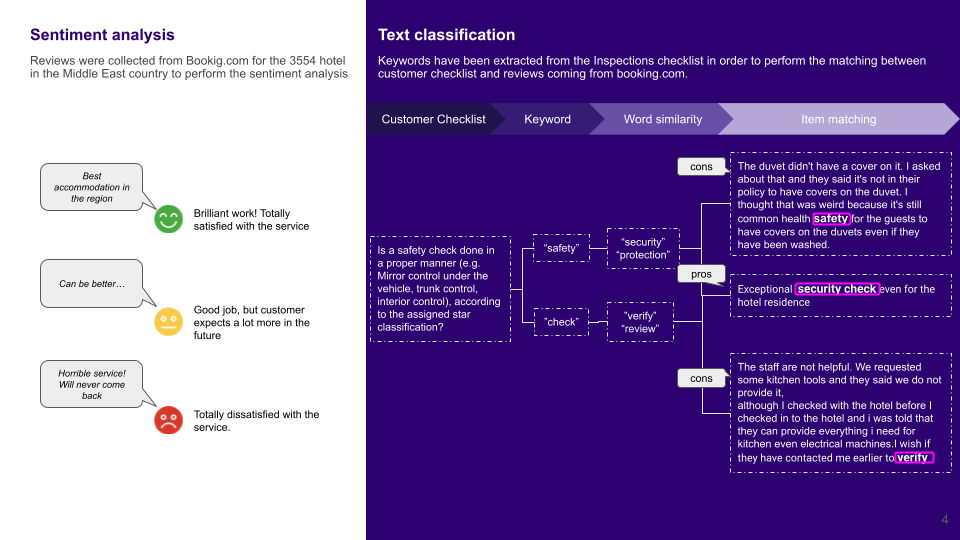
Outcome: Advanced NLP models analyzed review sentiments, identified recurring themes, and extracted actionable insights. These models:
- Measured satisfaction levels based on reviews.
- Identified main issues highlighted by visitors.
- Provided sentiment highlights for each item. This analysis offered the customer a deep understanding of visitor preferences and pain points, enabling targeted improvements and resource prioritization.
Use Case 3: Inspection AI
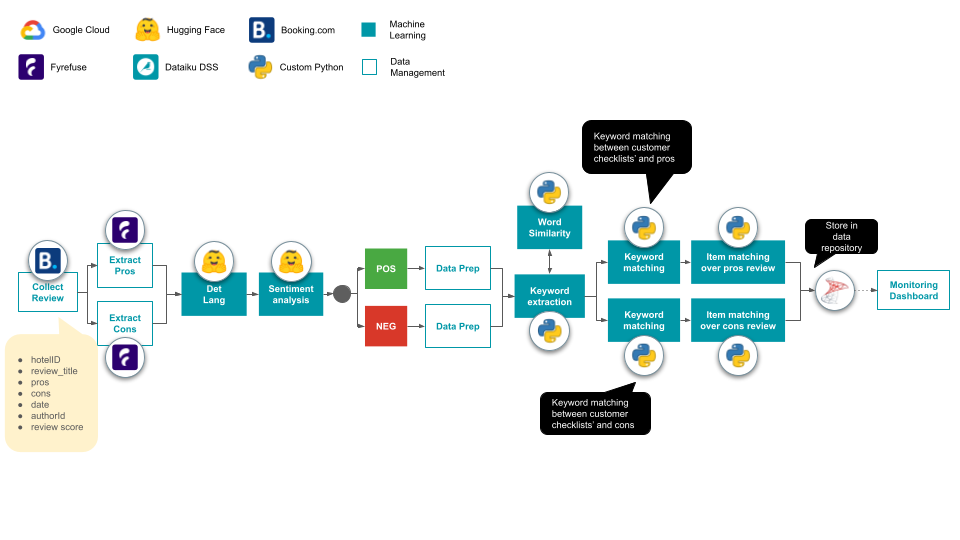
Scope: The focus was on streamlining and enhancing the inspection process for accommodations.
- Data: Data collected from the first Use case were loaded into the Recommendation Engine.
- Analytics: Machine learning models analyzed the data to identify potential violations of the customer’s accommodation checklists.
- Recommendation: Business rules were applied to the analytics output to generate actionable recommendations.
- Inspection Trigger: These recommendations were reviewed and validated by the inspection team, which then triggered necessary follow-up actions.
- Release: All recommendations and inspection outcomes were pushed to a centralized monitoring Application for real-time insights and operational use.
Outcome: The Inspection AI system provided the foundation for the Recommendation App, ensuring seamless integration of recommendations into the operational workflow. Key achievements included:
- Identification and implementation of the best-suited machine learning algorithms for detecting violations.
- Efficient identification of probable infractions.
- Deployment of the final solution live, ready for long-term use and continuous improvement.
Y2Y RESULTS
- 1.5M guest reviews (in 35 different languages) analyzed
- 30,243 autonomously recommended inspections
- 26,811 violations identified
- 345 accommodation facilities suspended